Pages

Showing posts with label HBO. Show all posts

Jun 25, 2014

ORPHAN BLACK 2/10 RECAP

As much as I liked the first episode of this season, the finale left me extremely frustrated. Conspiracy stories only work if the writers know (in essence, at least) what they want to come to in the end of the entire series, and unfortunately, it seems that John Fawcett and Graeme Manson invent stuff on the go (actually, they don't even try to hide it in their interviews, for example, they said they wanted to kill Mark off in the sixth episode, and look what happened). I can relate to their desire to try new things, including those from the technical point of view, but sadly "we thought it would be fun to try" approach rarely doesn't lead to chaos.


Anyway. To get Kira back, Sarah gives in to Dyad, and after having answered numerous questions about her sexual life and pregnancies (dramatic as they sounded on the show, there hardly was a single question that no woman has heard from her gynecologist), she signs a consent for having her eggs removed. Delphine gets relocated to Frankfurt, but she manages to send a file to Cosima with the exact time when this procedure takes places. In order to help her sister, Cosima turns a fire extinguisher into a pencil shooting mechanism. Scott volunteers to help Sarah escape and infiltrates the group of doctors performing the surgery.


People outside of Dyad also work on Sarah's release. Cal comes to Mrs S and says he's managed to get in touch with someone inside the institute over the internet. To prove this, he begins chatting with the mysterious person and mentions that he's with S. Then this person asks about [project] Castor - something that Siobhan seems to know about.


She arranges a meeting of the secret person with Paul, who, as it turns out, was a double agent all along and worked for both the Dyad people and the military. He brings documents on project Castor and gives them to the Dyad insider - Marian, who promises to release Sarah and Kira in exchange.


Rachel tries to get Duncan's key to the synthetic sequences, but he poisons himself with a special tea bag and dies right in front of her eyes (plural for now). When she overcomes this personal tragedy, she visits her sister in the ward, ready for the operation, gives her a picture that Kira has drawn with Cosima earlier on and asks for the key. Sarah says she knows nothing, so the psycho clone destroys Kira's bone marrow. Luckily, Sarah notices a fire extinguisher on the drawing - an odd thing for an eight year old to sketch, and finds one in real life, next to her bed with the label saying "sqeeze". So she does, and this leads to Rachel catching a pencil with her eye. Scott unties Sarah and gives her his access card.


This turns out unnecessary, as Marian had all doors open already, so Sarah and Kira escape the institute without any issues. 

Helena gets to Art's apartment, and the highlight of the episode for me was when she responded with "noo" to a question whether or not she has burnt the Prolethean's camp, grinning. The four semi-good clones get together under Felix's roof and dance (???). At night Helena leaves her frozen eggs inside and walks out, just to be abducted by the military at the door.   


Sarah comes to Marian's mansion, where she sees a younger version of herself - the only survivor of Dyad's 400 attempts to create another clone. We finally get to know what project Castor is - the military worked on male clones and Marian somehow got a hold of one faulty copy that looks exactly like Mark, only seems a bit more retarded. In the meanwhile another Mark-faced individual guards a military plane that Helena is escorted onto. Seems that Mrs. S has helped Paul to arrange the abduction in exchange for Sarah's freedom. At about the same time the real Mark marries Gracie, and one can only guess, whether he's a double agent, interested solely in Helena's baby inside of his fiancee or not. 


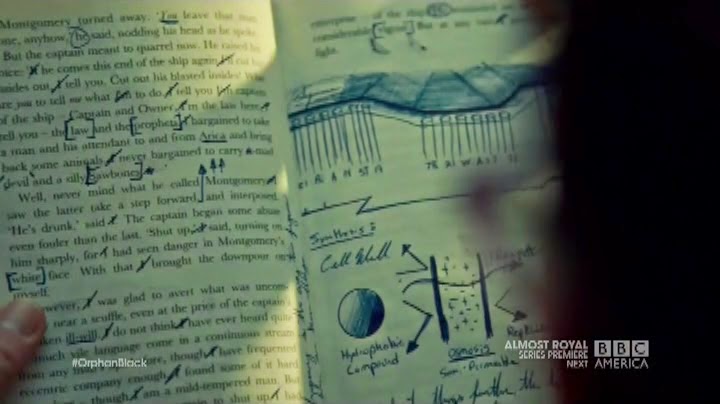
Cosima nearly dies, but Kira sort of brings her back to life, asking to read a book for her. After having listened to some childish story about puppy, the girl asks her aunt to read Duncan's book. Cosima opens it and sees something that looks like the key to the sequence inside. 

People say the introduction of male clones was inevitable, but I don't agree. We could easily live without them. Sure, this season focuses on ethical issues of having humans turned into science projects, but it's not why I enjoy the series. There's this part of the show that describes how different the seemingly similar women are, and how they get along, against all odds, and how they are willing to risk their lives for one another. The strength of this bond and this story line will be weakened by the male clones, I'm afraid. Besides, male body has never been as objectified and as... I wanna say politicized? Meaning there are still pro-life vs pro-choice wars on a national level in many countries. So hardly this new development can really add any significant emotional component. And storywise it's gonna be a mess. Well, whatever.


Apr 7, 2014

SILICON VALLEY S01E01 REVIEW

Silicon Valley premiered last night on HBO, so I'll write a couple of words about it.

Synopsis:

Richard lives in a Silicon Valley incubator with four other geeks and works for a global tech company Hooli; his own project develops very slowly, until two billionaires, Peter Gregory, who hates college education (I'm with him on that, by the way), and the founder of Hooli, Gavin Belson, find out about the algorithm he wrote that allows to compress files without any data loss. Naturally, they want in, and Richard must decide, which offer he would accept.


In may ways, it's like Better Off Ted meets The It Crowd, only without the awkward romantic relationships (well, at least for now, I definitely sensed the potential love story between the lead and the college-hater assistant) and any normal people. The series portrays the ridiculousness of the tech world, populated with the suddenly rich social freaks, who can't think of spending cash on anything better than a performance by Kid Rock (!) at their party. 

The tech world is divided. On the one side there are billionaires driving exceptionally narrow cars and talking to the spiritual advisers. On the other side - the nobodies, the guys who have gotten the shit kicked out of throughout all their lives, the guys who do not want to change the world, or even get rich, for that matter; they just want to make it happen, without fully realizing what it is.


The acting is exceptional and is essential to the show. Most of the jokes are funny just because of the tone and the facial expressions. And of course, the creators couldn't not introduce the typical American comedy character - the insensitive doctor. Only here, on top of delivering the usual anatomical jokes, the doctor is pitching his patients with his app idea.

The episode ends with Richard's speech about how he doesn't want his company to turn into any other "corporate cult", and that was probably the funniest part of the show. We've seen it all before; the most dramatic example is, of course, Google; the company, famous for fighting "the evil" (i.e. Microsoft), has turned into... well, whatever it is now.

So, whether you love or loathe the tech world, this show is definitely worth checking out.

Oct 31, 2012

GAME CHANGE: "ALASKA'S PRETTY TOUGH"

It took me quite some time to watch this movie, and frankly, it had not even been on my list until it got so many Emmy awards. Honestly speaking, I don't like movies in general, especially those over one hour - I have very short attention span. But I love it when political processes are getting publicly dissected, so I actually enjoyed watching this one.

Game Change (HBO) was based on a book of the same title, written by political journalists Mark Halperin and John Heilemann about McCain/Palin campaign of 2008. Both Palin and McCain claimed the book and the movie to be false or inaccurate, though some of the campaign insiders, including chief strategist Steve Schmidt, who was also portrayed in the movie, seemed to believe otherwise.


In short, the movie is about how Palin (played by Julianne Moore) has been chosen as a VP candidate for a very wrong reason and how she managed to gain nation wide popularity without an adequate level of competence or the appropriate manners.

This movie left me with some mixed feelings. In terms of telling a story it was good and overall interesting to watch. Surprisingly, Sarah Palin comes out as a very humanly, almost sympathetic character, despite the fact that Game Change is clearly pro-Democratic. OK, she doesn't know shit about foreign or, for that matter, national politics, but it's not her competence she gets chosen for, is it? McCain's character was, to my shock, even more likable, which I could never say about this person IRL.

 
To the downsides. I like to think of myself as a liberal (well, for the most part that is), but it does not feel right to me that the story is perpetually rolling around Palin's ignorance, whereas, let's say, her dreadful rhetoric, which is still contributing to the country division, is barely even touched (they do talk about it, but I do not think it is thoroughly illustrated).  

I know, it must be extremely difficult to portray some real life person, especially, if this person is still all over TV. Julianne Moore was praised for her performance, but I actually believe Ed Harris did a better job. I swear, at times his gestures and mimics made my brain replace him with the image of real McCain and the makeup people did not even have to yellow his teeth! (That's very low of me to mock someone's physical features, I know, but I'm still very far from becoming Joan Rivers, aren't I?). I did not have these moments with Moore's Palin, it might be because I know the actress very well and can't subconsciously let go of this fact. Or it could be because though it is fairly easy to copy Palin's looks, imitating her gestures, manner of speech, facial expressions - not so much.


And then I did not think it was such a great idea to use the actual footage of Obama/Biden, because it made me even more aware that McCain/Palin are played by actors. The reporters I could take, but making Moore fake debate Biden in no way made it feel real, but I'm sure critics believed otherwise.

Talking about the current US President, the most fascinating idea of the entire movie was that Palin and Obama are fundamentally similar, only one of them is smarter and better educated. The non-achievers, the talkie-talkers with drive and charisma, they gained people's support by simply speaking, and their speeches remained to be their greatest achievements. To understand the mesmerizing effect Obama had on most of the world we just need to remember that he's got the Nobel Peace Prize, and this is not a freaking fiction, this is the fact that we have to live with for the rest of our lives.

Anyway, back to the movie. Although I admit that personalities are properly illustrated there, I regret to say that the things what I watch political movies or shows for are not. Tricks, tactics and techniques, typically used in campaigns like that, are presented very vaguely, and since they are ultimately not working, I have hard time understanding why they could be considered as valid in the first place. The only politically calculated, dubiously moral approach that is given a proper narration is the one that is addressed in Anderson Cooper's question, whether Palin has been chosen for being more appealing to Republican voters, rather than for being actually fit for the role of Vice President of the United States. And maybe the reason behind this choice has not been so boldly obvious to the average voter. But other things like when fair criticism of a candidate by reporters is presented to the public as a politically motivated attack, or when no one spends the money on campaigning in states that are either steady "red" or are more than likely to vote "blue" (vice versa for the Democrats, of course), or the whole practice of releasing pieces of negative information about the opponent - they are neither new nor there is anything in executing them that we wouldn't know. So, in terms of political system overview, this movie did not feel like an insider story, more like an anecdote told by an observer from the outside, who happened to overhear a couple of chitchats, but without any particular details.

Well, how shall I end this piece of writing? I guess, by saying that Game Change is a fine movie. The story, though is not told the way I would prefer it to be, is a compelling one, and whereas I can never know how accurate, if at all, it is, it does give a general idea about the source of the whole Sarah Palin phenomenon. In the end, when McCain gives his concession speech, his adviser Steve Schmidt (Woody Harrelson) has a face expression, when he hears the crowd chanting "Sarah", as if he realizes that he is Dr. Frankenstein; well, he isn't. It's not the political advisers, who made Palin who she is now, they only put some light on her due to their own shortsightedness; the rest of work has been done by her and the people who see themselves in her.


The people of America are facing another presidential election now, and from the other continent it feels that sadly, neither of their options could be the right choice.